sexta-feira, 4 de setembro de 2009

london days

London Days

20, 21, 22...

Westminster Abbey

As I arrived in London, I had to move to my new house (Maria Mencia’s place) and rearrange my economical situation. The place is quite nice, is quiet and close to a cemetery. We are in Dulwhich, which is close to Brixton. It is good to be in a calm place. When I go to London I feel a bit uneasy. The city is so crowded, there are so many people everywhere all the time, that it really makes me confused. But London has good collections, so I can take the time to see some of them, organizing my research and writings and plan new trips. I have this idea of going to Holy Head, maybe south Ireland and Scotland. There are some places nearby I would like to go. So, there’s still a lot to do.

So I will not be very strict in this time, because I am not really traveling, but I will return to the old style when I take the road again.

This little building called my attention: it gets close to Victoria Station and it looked a lot Roman to me, although it would be quite unlikely, as the city passes through so many transformations along the centuries that would be impossible this little building remain untouched. However this was a starting point to me in London.


little building in lower grosvenor square

the decoration looks pretty much roman

Yesterday – the 21- I went to the British Museum, and it was a really good choice. They have a good collection on Celtic and pre historic artifacts, apart of texts and maps, so it was good to see – and eventually touch- some of those objects.


British Museum

the flint industry last for thousands of years

an ancient "mill": as the first crops came imported by the East, new technologies had to be adapted to local realities

the first farmers would clear and divide the land, and some of their efforts are seen even today


some bronze age objects are still of unclear meaning like these stone drums

...or these stone balls

these farmers would create the most famous monuments to celebrate their dead and important time passages

depending of their beliefs the bodies would be cremated or buried

reconstruction of a bronze age village

the work with metal spread fast throughout British Islands

and bring new settlers

these shields were not strong enough for battles, they should serve to ceremonial purposes


the bronze and iron age witnessed new kinds of art in england


that's when appear the first weapons


and the fortifications


copper and silver found in England


that's when the Romans arrived in Britain and explored the area for 4 centuries

I acquired a book about the Celts, as it gets the time to get more informed about people in Britain pre Roman. Actually I feel like I am studying all Britain’s history, and I am enjoying that. As I’ve been writing the blog a lot of new information arouse, so it’s good to have this time.

the druids as imagined by 19th century scholars

quinta-feira, 3 de setembro de 2009

day 19 - hereford

Day 19

HEREFORD


Last day in Hereford, tomorrow morning go to London. I’ve got all set up: found the bus station, the time table (there’s one departing 10:15), the ticket office (which stands in other area of the town) and got a ticket for £20. Not bad at all. So I could go for some exploration in the city, which I found to be worthy than just stay indoors at the museum, although there is still a lot I want to see on Watkins photos.

HEREFORD CATHEDRAL


But I wanted to see the universe around him too, so I decided to go to the Hereford Cathedral, which contains nice examples of Romanesque stone decoration into a gothic style. The building has a red color on the outside and it is white gray inside. The stained glass are of this church are remarkable, as in many other cathedral in England. But in this particular case it seems that is more evident its quality, although is visibly work that spammed long period of time. The stone work of the cathedral is very nice too, and it combines the more decorative Romanesque with the styles which came after. As a cathedral, has the bishops buried and the Saint Ethelbert, for whom the church is dedicated.


the romanesque stile


some Green Men to sell


chapel inside the cathedral

can everybody just leave me alone?

some of the beautiful glass works


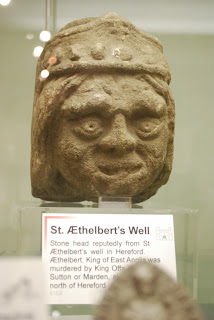
this head was recovered from a well and depicts the head of St. Aethelbert


the brass of St. Ethelbert in the Cathedral

This saint was born son of king Ethelbert in 794. The history says he was urged to marry, and despite of bad signs like visions, an earthquake and an eclipse, Ethelbert went to Mercia to ask the hand of the daughter of King Offa. Her wife convinced him to kill his host, so the King contract someone that murdered him cutting his head. Just after that many miracles been attributed to him. His body was transferred to the Cathedral. His head lays at Westminster Abbey.


the mappa mundi

The Cathedral is also notable for its library, one of the few Chain Library totally remaining in the world. A Chain Library means that the books are literally chained to their shelves. This library contains one copy from 1217 of the Magna Carta (originally written in 1215), and the Mappa Mundi, the largest medieval world map known.

This map drawn in vellum around the year of 1280 by a certain Richard of Haldingham and Lafford, has impressives158 x 133 cm. It is possible to see many legends and medieval conceptions in it, as well some achievements into geography (as the mention of Faroe Islands in a map) and, of course, a lot of medieval imagination. In the map are depicted the Paradise, the Crete Labyrinth, beasts of all sorts, as well imaginary creatures like scipodes and mermaids.


stone carvings at the Cathedral's façade
HEREFORD CITY WALLS


I’ve visited other churches in the city, as Alfred Watkins have registred some Ley lines in Hereford and surroundings. But this may have to wait. I’ve been following the remains of the city walls, but there’s no much to see although in some areas the line is clear until today.

MISERICORD BENCHES AT ALL SAINTS CHURCH

These very special carvings are the misericord benches at All Saints, which is a particular church. It still held services although there is a cafe inside amongst other small business.
The carvings have this special medieval flavor, expressionist and symbolic at once.
There were even a Green Man amongst them.


THE OLD HOUSE
The Old House

This is a very famous house in the center of the city. It is the one that remained from a group of houses from the 17th century. The quality of the carvings around the house, the actual location and its unusual feature made it famous. Alfred Watkins donate a chair to the little museum inside the house.


more Green Men at the façade of the Old House

the chair donate by Alfred Watkins


SAINT JOHN CHURCH

a small medieval extravaganza at St. John's

I still been looking for a biography of Watkins that Christine showed me, but could not find it, not even in the second hand stores. But in a particular one, I could find very interesting (and cheap) books on ancient places in England. Both of these books are very good, and in will be very useful in time. The owner told some good stories about Watkins, and that he was known for drinking a lot (since his father had a brewery), and he used to visit each and every pub in town. He even lived in one for a while (The Imperial).


Well, after that I still been walking around the city and been to know some other places in central Hereford. It was a nice day, with some interesting places and things to see. The big travels through Herefordshire I still have to plan. Maybe the fellows of Alfred Watkins can help me then.